
Last weekend, I was stuck in Division 6, getting absolutely battered by opponents who seemed to predict my every move. My passes? Intercepted. My shots? Saved or blocked. My defense? Let’s not even go there. Then something clicked after I watched a replay of my own gameplay, and honestly, it was humbling. I was making the same three mistakes over and over again.
Fast forward one week, and I’ve climbed two divisions with a win rate that’s finally something I’m not embarrassed to share. The difference wasn’t spending money on packs or getting lucky with player pulls. It was understanding how to win more matches in EA FC 25 Ultimate Team through smarter tactics, better squad building, and honestly, just paying attention to what actually works in this year’s game.
If you’re grinding through Ultimate Team feeling like everyone else has some secret playbook you weren’t given, I’ve got good news. The gap between average and genuinely good players isn’t as wide as you think. In this guide, we’re breaking down everything from formation selection to in-game adjustments that’ll transform those frustrating losses into satisfying victories. Whether you’re chasing Weekend League rewards or just want to enjoy Rivals without the rage quits, let’s get you winning.
Understanding EA FC 25’s Gameplay Meta
Before we dive into tactics, let’s talk about what actually matters in EA FC 25’s current meta. This isn’t FIFA 23 where pace abuse won everything, and it’s definitely not last year’s crossing simulator. EA’s tuning patches have shifted the game toward something that (surprisingly) resembles actual football.
The biggest change? Defending is manual now. Like, genuinely manual. You can’t just hold contain and let the AI do the work anymore. I learned this the hard way when my 88-rated center backs were getting cooked by gold-tier strikers because I was being lazy with my defensive positioning.
Passing has weight this year. Those through balls that used to laser-guide themselves to your striker’s feet? They’ll get cut out if the passing lane isn’t actually open. You need to actually look before you pass, which sounds obvious but goes against muscle memory from previous titles.
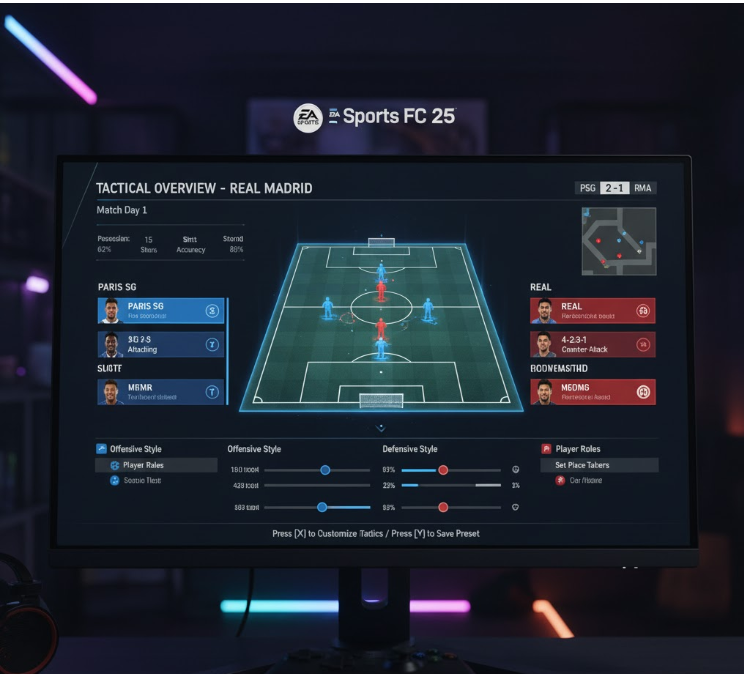
The skill move meta has also evolved. While skills are still effective, spamming them doesn’t work like it used to. The most successful players I’ve faced use skills selectively—one or two moves to create space, not fifteen in a row hoping something sticks.
Interestingly, build-up play matters more than it has in years. Quick counters are still deadly, but you can’t rely on them exclusively. Learning to patiently work the ball and exploit defensive gaps is crucial for consistent wins, especially against better opponents who’ve mastered defensive positioning.
Squad Building Fundamentals That Actually Matter
Here’s where most players get it wrong: they think Ultimate Team is about collecting the highest-rated players. Wrong. It’s about collecting the right players who fit your system and have chemistry with each other.
Chemistry is king in EA FC 25. A full chemistry team of 84-rated players will outperform a low-chemistry squad of 87s every single time. I’m talking noticeable differences—better positioning, sharper passing, improved shot accuracy. The game literally nerfs your players’ stats when chemistry is poor.
Focus on building around a core nationality or league first. Premier League squads are popular for a reason—tons of good links, affordable options at every position, and genuine meta players scattered throughout. La Liga and Bundesliga offer excellent value too, especially if you’re working with a limited budget.
Pay attention to work rates. This one’s subtle but game-changing. Your striker with High/High work rates might be constantly dropping deep, leaving you with no one in the box. Your fullbacks with High attacking work rates? They’re probably pushing forward and leaving gaps in defense. I run High/Low on my strikers and Medium/High on fullbacks, and the positional discipline is night and day different.
Don’t sleep on player body types and animations. A 6’2″ center back with the “lengthy” acceleration type will catch those pacey strikers better than a smaller defender with higher pace stats. Similarly, players with unique body types (think Haaland, Van Dijk) have animations that make them more effective than their face stats suggest.
Formation Selection and Custom Tactics
Your formation isn’t just about how players line up at kickoff—it defines how your entire team moves throughout the match. I’ve experimented with probably fifteen different formations, and here’s what actually works in EA FC 25 Ultimate Team.
The 4-3-2-1 is quietly one of the most balanced formations this year. You get width from your fullbacks, three midfielders for control, and a narrow attack that can quickly overload the box. Set your defensive width to 45, depth to 55, and you’ve got a formation that transitions smoothly between defense and attack.
The 4-4-2 remains a solid choice if you struggle with midfield control. Two strikers give you consistent options in attack, and the flat midfield four provides good defensive coverage. The key is setting one striker to “get in behind” and the other to “false 9” so they’re not occupying the same spaces.
For players who love possession football, the 4-1-2-1-2 (narrow) is your friend. That single CDM provides defensive stability while your attacking four can create triangles and quick passing combinations. Fair warning though: you’ll struggle against opponents who use wide formations unless you manually track those runs.
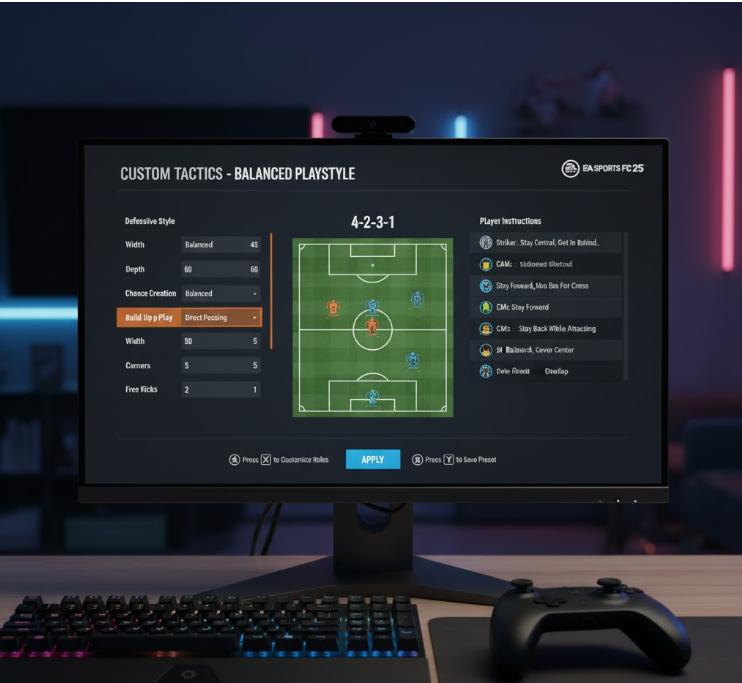
Here’s a pro tip that changed my game: use different tactics for different scenarios. Set up a defensive tactic for when you’re protecting a lead (drop back to 35 depth, possession playstyle), a balanced default, and an ultra-attacking tactic for late-game comebacks. You can switch between these with the D-pad during matches, and it’s like having three teams in one.
Custom tactics matter more than most players realize. If you’re using default tactics, you’re leaving performance on the table. Spend time in the tactics menu tweaking your build-up play (I prefer balanced), defensive approach (press after possession loss works great), and width settings based on your formation.
Defensive Strategies That Stop Goals
Defense wins championships in Ultimate Team, yet it’s the area where most players are weakest. I used to concede three or four goals per match until I completely rewired how I approached defending.
First rule: stop controlling your center backs. Seriously. The moment you manually select a CB, you’re pulling them out of position and creating gaps. Instead, control your CDM or closest midfielder and use them to track runs, clog passing lanes, and apply pressure. Let your CBs hold their defensive line automatically—they’re smarter than you think when left alone.
Jockeying is your best friend. Hold L2/LT and move with your opponent rather than diving in for tackles. This year’s game punishes mistimed tackles hard, leaving you watching helplessly as your defender recovers while their striker slots it past your keeper. Patient jockeying forces opponents into mistakes and keeps your defensive shape intact.
Learn to manually cut passing lanes. When your opponent has the ball, don’t just chase it. Position yourself between the ball carrier and their most dangerous passing option. You’d be amazed how many attacks break down when you remove their first-choice pass. This requires reading the game and anticipating, but it’s the difference between Division 6 and Division 1 defending.
Second man press (R1/RB) is a tactical nuke when used correctly. Send an AI teammate to pressure while you manually cover passing lanes or mark dangerous runs. But here’s the catch: overuse it and you’ll get shredded on counters because your players will be out of position. I use it in their final third or when I desperately need to win the ball back.
Don’t ignore set piece defending. I used to skip the cutscene and let the AI handle corners and free kicks. Bad idea. You’re giving away easy goals. For corners, manually position your tallest player on the front post and contest every header. For free kicks just outside the box, add an extra man to the wall and manually position a defender to block low shots.
Attacking Tactics to Break Down Any Defense
Scoring goals in EA FC 25 requires patience and variety. If you’re just sprinting down the wing and cutting back every attack, good defenders will read you instantly and shut you down. You need multiple weapons in your attacking arsenal.
Possession with purpose beats pace spam. Work the ball around the midfield, shift the defense from side to side, and wait for gaps to appear. I know it’s tempting to force that through ball the second you cross midfield, but disciplined opponents will intercept it ninety percent of the time. Instead, recycle possession, make them move, and strike when space opens up.
The driven pass (R1/RB + X/A) is criminally underused. It’s faster than regular passing and cuts through traffic that would intercept normal passes. I use driven passes for switching play quickly or threading balls through congested midfields. Once you get comfortable with driven passing timing, your attack becomes significantly less predictable.
Master the basics of skill moves. You don’t need to be a skill spammer, but knowing how to execute a ball roll, fake shot, and stepover will create those crucial moments of separation. I primarily use fake shots (shoot then pass) to quickly change direction and create shooting angles. Simple, effective, repeatable.
Learn finesse shot timing. This year, finesse shots from the edge of the box are incredibly effective when timed correctly. Approach the box, take a touch to create space, and finesse far post. I’d say sixty percent of my goals come from this exact pattern because it’s reliable and hard to defend if you vary the timing.
Don’t ignore headers. Yes, crossing got nerfed compared to last year, but well-timed crosses to tall strikers still produce goals. The key is crossing when your striker actually has space, not just whipping it in and hoping. Use driven crosses (triple tap cross button) for faster delivery when your striker is making a run across the defender.
Player Instructions That Transform Your Team
Player instructions are where you fine-tune your eleven players to work as a cohesive unit rather than eleven individuals doing their own thing. Getting these right is the difference between a squad that flows naturally and one that feels clunky despite having great players.
For strikers, I run one on “get in behind” with “stay central” and the other on “false 9” with “drift wide.” This creates natural movement where one striker pins the backline while the other drops deep to link play. Both should be on “stay forward” so they’re not tracking back and wasting stamina.
Your CAM or attacking midfielder should be on “stay forward” and “get into the box for cross.” This ensures you have multiple attacking threats in dangerous positions. Some players prefer “free roam” here, but I find it makes the CAM drift too wide and leave the center open.
Fullbacks are crucial this year. I set mine to “balanced attack” with “overlap.” This gives them freedom to support attacks when safe but keeps them back when needed. If you’re facing a pacey winger who’s destroying you, quickly change that fullback to “stay back while attacking” via the quick tactics menu.
Your CDM (or defensive midfielder) should be on “stay back while attacking” and “cut passing lanes.” This creates a safety net that catches counters and maintains defensive shape. If you run two CDMs, you can set one to “balanced” for more midfield presence, but always keep at least one sitting deep.
Wingers are interesting this year. “Come back on defense” is useful if you struggle defensively, but it limits their attacking threat. I prefer “balanced” with “get in behind” and “get into box for cross.” This keeps them involved in both phases without exhausting them with constant tracking back.
Comparison of Popular Formations and Their Strengths
| Formation | Defensive Stability | Attacking Threat | Midfield Control | Best For | Weakness |
|---|---|---|---|---|---|
| 4-3-3 (4) | High | Moderate | High | Possession play, wide attacks | Can feel slow in transition |
| 4-4-2 | High | Moderate-High | Moderate | Balanced approach, beginners | Midfield can get overrun |
| 4-1-2-1-2 (Narrow) | Moderate | High | High | Quick passing, through balls | Vulnerable to wide play |
| 4-3-2-1 | High | High | Moderate | Balanced, versatile | Requires good fullbacks |
| 4-2-3-1 (Wide) | Moderate-High | High | Moderate-High | All-around play, meta option | CDMs need good stamina |
| 3-5-2 | Moderate | Very High | Very High | Aggressive players, skill moves | Exposed wings if caught forward |
Understanding formation strengths helps you counter opponents and exploit their weaknesses. When I see a 3-5-2, I know their wings are vulnerable, so I focus on stretching play wide and attacking those spaces.
In-Game Adjustments That Save Matches
Even with perfect tactics, you’ll need to adapt during matches. The ability to read your opponent and make smart adjustments separates good players from great ones. I’ve won countless games by making the right changes at halftime or when momentum shifted.
If you’re getting dominated in midfield, switch to a formation with more central players. Going from a 4-4-2 to a 4-3-2-1 or 4-1-2-1-2 adds bodies in the middle and helps you regain control. Don’t be stubborn—if something isn’t working, change it.
Substitutions matter more than you think. Around the 60th minute, bring on fresh legs in key positions. I always sub my CAM and one striker because these positions demand the most stamina. A tired attacker with 88 pace plays like they have 75 pace, while a fresh 80 pace sub feels rapid.
Pay attention to your opponent’s patterns. Does he always cut inside with his right winger? Start positioning your fullback to cut off that lane. Does he spam through balls? Drop your defensive line deeper. Recognizing patterns mid-match and adjusting accordingly wins games you’d otherwise lose.
When protecting a lead, don’t just park the bus. That invites pressure and usually results in conceding. Instead, switch to a possession-focused approach with slightly deeper defensive depth (around 40-45). Keep the ball, make them chase, and hit them on the counter when they commit forward.
Trailing late in the game? Switch to ultra-attacking tactics, bring on your fastest attackers, and play more direct. Possession football won’t help when you need two goals in ten minutes. Sometimes you need to take risks and hope they pay off.
Weekend League and Division Rivals Strategy
The mental game matters just as much as the tactical one when you’re grinding Weekend League or pushing for promotion in Division Rivals. I’ve lost matches I should’ve won purely because I tilted after an unlucky goal or rebound.
Take breaks between matches. Playing five straight games when you’re frustrated is a recipe for disaster. Step away, reset mentally, and come back fresh. My win rate is noticeably higher in games one and two of a session compared to games five through seven.
Accept that scripting theories might have some truth, but they’re out of your control. Whether momentum/DDA exists or not, focusing on it won’t help you win. Control what you can control—your tactics, player selection, and in-game decisions. Everything else is noise.
For Weekend League specifically, pace yourself. You have from Friday to Sunday to complete matches. Don’t try cramming them all into Saturday night when you’re exhausted. I spread my games across the weekend, usually playing 5-7 per day maximum.
In Division Rivals, understand that promotion requires consistency. You don’t need to win every match, just more than you lose. Some losses are learning opportunities. Save replays of matches where you got dominated and study what went wrong. It’s uncomfortable but invaluable.
Don’t rage quit, even when you’re getting thrashed. EA’s matchmaking uses more than just wins/losses to match you with opponents. Completing matches (even in defeat) helps ensure fairer matchups going forward. Plus, you still earn Division Rivals progress and match coins.
Budget Beasts and Meta Players Worth Using
You don’t need an icon-stacked mega team to compete in EA FC 25 Ultimate Team. Some of the most effective players are surprisingly affordable, and knowing which ones punch above their rating gives you a massive advantage on a budget.
In defense, Bayer Leverkusen’s Tapsoba is an absolute monster. He’s got the lengthy body type, great defensive stats, and costs under 20k coins. Pair him with someone like Akanji from Manchester City, and you’ve got a partnership that’ll stop most attacks cold.
The midfield is loaded with value options. Fede Valverde from Real Madrid is everywhere on the pitch—he intercepts, tackles, passes, and even scores when needed. Declan Rice offers similar value in the Premier League if you’re building around that league. Both feel like they’re worth triple their actual price.
Up front, look for strikers with unique body types and good positioning stats. Marcus Thuram is rapid, strong, and his animations make him feel like an icon card. Ollie Watkins from Aston Villa offers similar value with better links for Premier League squads.
Don’t ignore special cards from minor leagues. Players like Gyökeres from Sporting CP or Jonathan David from Lille offer insane value because fewer people are using them. They link into hybrid squads easily and perform way above their rating.
For goalkeepers, height matters more than overall rating. Grab someone 6’4″ or taller with decent reflexes, and you’re set. Maignan, Onana, and Donnarumma are all under 10k and perform like top-tier keepers.
Common Mistakes That Cost You Games
Even after improving significantly, I still catch myself making dumb mistakes that gift opponents easy goals. Recognizing and eliminating these errors is probably the fastest way to improve your win rate.
Sprinting too much is mistake number one. New players hold the sprint button constantly, which tanks your stamina and makes players less responsive. Sprint in short bursts when you actually need the speed boost, not as a default movement mode. Your players will last longer and feel smoother.
Forcing passes that aren’t there gets me in trouble constantly. You see your striker making a run, you desperately want to hit him, but there are three defenders in the passing lane. That pass gets intercepted ninety-five percent of the time. Be patient, recycle possession, wait for a better angle.
Neglecting stamina management loses more matches than people realize. By the 70th minute, if your entire team is gassed, you’re basically playing at a handicap. Use team press sparingly, don’t chase the ball like a maniac, and make those 60-minute substitutions to keep your team fresh.
Overusing skill moves is a trap. Yes, skills create space, but doing five stepovers in a row just gives defenders time to position themselves. Use one skill move to beat your man, then exploit the space you created. Quality over quantity.
Ignoring the radar/minimap is like playing with one eye closed. I glance at it constantly to spot open teammates, track opponent runs, and identify space to attack. So many players tunnel-vision on the ball carrier and miss the wider picture. That radar is feeding you information—use it.
Training Mode and Skill Games That Actually Help
The training arena isn’t just for trying out new players—it’s where you build the muscle memory that transforms average players into consistent winners. I spend fifteen minutes in training before every session, and it genuinely makes a difference.
Practice finesse shots from various angles around the box. Set up the shooting drill, and just take shot after shot from different positions. This builds the muscle memory for power, placement, and timing. When that shooting opportunity appears in a real match, your hands already know what to do.
Work on skill move chains in a controlled environment. Pick two or three skills you want to master, then practice transitioning between them smoothly. I spent hours perfecting the ball roll scoop turn combo, and now it’s second nature when I need to create space in the box.
The defensive drills teach jockeying and tackle timing better than any YouTube tutorial. Run through the scenarios where you have to track an attacker and time your tackle. It’s boring but effective. Your defensive discipline will improve dramatically.
Free kick practice is underrated. Most players skip free kicks or just blast them hopefully at goal. Spend time learning the different free kick types—knuckleball, finesse, driven—and when to use each. Free kicks are basically free shots on goal if you know what you’re doing.
Don’t skip the advanced shooting scenarios. Volleys, headers, first-time finishes—these situations happen constantly in real matches, but most players haven’t practiced them specifically. Five minutes of volley practice will win you matches when that perfect cross comes in and you actually convert it instead of blasting it over the bar.
Conclusion
Winning more matches in EA FC 25 Ultimate Team comes down to understanding the game’s mechanics, building a cohesive squad, and making smart decisions both before and during matches. It’s not about having the best team or getting lucky—it’s about playing smarter football.
The beauty of these strategies is they work regardless of your team’s overall rating or your coin balance. Sure, better players make things easier, but tactics, chemistry, and smart gameplay beat expensive squads piloted by average players every single time. I’ve beaten teams worth millions of coins because I understood formation matchups and made the right in-game adjustments.
Start implementing these tips gradually. Don’t try overhauling everything at once—that’s overwhelming. Pick one area to focus on (maybe defensive positioning or custom tactics), master it over a few sessions, then add another element. Progress compounds quickly once you start seeing results.
Now get into that next match with confidence. You’ve got the knowledge—time to put it into practice. When you hit that promotion you’ve been chasing or finally crack that Weekend League rank you’ve been stuck below, come back and drop a comment about which tip made the difference. Let’s get those wins. See you in Division 1.
Frequently Asked Questions
What is the best formation for beginners in EA FC 25 Ultimate Team?
The 4-4-2 is the best formation for beginners because it provides excellent balance between attack and defense without requiring complex tactical understanding. The flat midfield four offers solid defensive coverage, while two strikers give you consistent attacking options. Set it to balanced tactics with 50 depth and 50 width to start, then adjust based on your playing style. As you improve, you can experiment with more complex formations like the 4-3-2-1 or 4-1-2-1-2.
How important is team chemistry in EA FC 25?
Team chemistry is crucial in EA FC 25 and directly impacts your players’ in-game performance. Full chemistry (33 points) boosts player stats significantly, while low chemistry actually nerfs their abilities. A team with 84-rated players at full chemistry will consistently outperform a team with 87-rated players at low chemistry. Focus on building squads with strong links through shared nationality, league, or club to maximize chemistry before worrying about individual player ratings.
Should I spend money on FIFA Points to build a better team?
Spending money on FIFA Points isn’t necessary to compete in EA FC 25 Ultimate Team. Tactics, chemistry, and player skill matter more than team rating. You can build a highly competitive squad through trading, completing objectives, and playing Division Rivals and Squad Battles rewards. Many top players in Division 1 use budget teams effectively. If you do spend money, invest in guaranteed packs during promotions rather than gambling on standard packs with terrible odds.
How do I defend against players who spam skill moves?
To defend against skill spammers, stay patient with jockeying (L2/LT) and don’t dive into tackles. Maintain distance and use the right stick to contain while cutting off their forward progression. Most skill spammers rely on you lunging at them to create space. If you stand your ground and force them wide or backward, they’ll eventually make a mistake. Use second man press (R1/RB) strategically to apply additional pressure while you manually cover passing lanes.
What’s the fastest way to earn coins without spending real money?
The fastest coin-earning methods are Division Rivals rewards (play to your rank thresholds), completing Squad Building Challenges with untradeable players, trading on the transfer market (buy low during content drops, sell high during Weekend League), and completing weekly and seasonal objectives. Avoid buying packs with coins—the return on investment is terrible. Focus on consistent play, smart trading, and completing marquee matchups SBCs. Building coin balance takes time but is completely achievable without spending money.
Additional Resources
For more detailed Ultimate Team guidance and meta updates, check out these trusted sources:
- EA Sports FC Official Site – Official news, patch notes, and game updates directly from EA Sports, including detailed explanations of gameplay mechanics and Ultimate Team features.
- FUTBIN – Comprehensive database of player stats, prices, squad builder tools, and community reviews. Essential for researching meta players, tracking market trends, and building chemistry-optimized squads.
- FUT.GG – Advanced analytics, custom tactics library, formation guides, and meta reports from competitive Ultimate Team players. Great resource for staying current with evolving tactics and player effectiveness.