
Picture this: it’s 2016, and some guy named ConcernedApe releases a farming game he made entirely by himself over four years. The gaming world collectively shrugs, then downloads it, and suddenly millions of people are staying up until 3 AM planting parsnips and romancing purple-haired NPCs. Fast forward to 2025, and we’re still talking about it.
I’ve returned to Stardew Valley more times than I can count. New save files after major updates, modded playthroughs when vanilla gets stale, co-op farms with friends who swear they’ll help but mostly just fish all day. Each time, I tell myself I’ll play for an hour. Each time, I emerge bleary-eyed six hours later wondering where my evening went.
But here’s the question that matters in 2025: with dozens of cozy games flooding the market, inspired by Stardew’s success, does the original still reign supreme? After Animal Crossing’s resurgence, after Dreamlight Valley’s Disney charm, after countless farming sims trying to capture that same magic, is Stardew Valley still the best cozy game you can play?
I’ve spent the last month diving back into Pelican Town, experiencing the 1.6 update that dropped earlier this year, exploring the thriving mod scene, and comparing it to the competition that’s emerged over nearly a decade. The answer is more nuanced than you might expect, and way more interesting than a simple yes or no.
What Makes Stardew Special in 2025
The Foundation That Still Holds
Let’s start with why Stardew Valley worked in 2016 and continues working today. At its core, it’s a love letter to Harvest Moon that fixed everything frustrating about those classic games while adding depth modern gamers expect.
The core loop remains addictive:
- Wake up, water crops, check animals
- Explore mines or fish or forage
- Talk to villagers, build relationships
- Expand your farm, optimize layouts
- Sleep, repeat, but it never feels repetitive
What ConcernedApe understood that many imitators miss is the importance of varied gameplay loops. You’re never doing just one thing. Farming funds mining expeditions. Mining provides resources for building. Buildings improve farming efficiency. Relationships unlock recipes and items. Everything interconnects without feeling overwhelming.
The game respects your time in ways that seem obvious now but were revolutionary then. Fast travel unlocks reasonably early. Automation becomes possible as you progress. You’re never forced into tedious busywork without purpose. Each system has depth if you want it, but you can ignore aspects entirely and still succeed.
ConcernedApe’s Continued Support
Here’s something wild: Eric Barone (ConcernedApe) has been updating Stardew Valley for free since 2016. No paid DLC. No premium currency. No battle pass. Just regular updates adding content because he wants to.
Major updates through 2025:
- 1.4 (2019): Multiplayer overhaul, fish ponds, new areas
- 1.5 (2020): Ginger Island, split-screen co-op, late-game content
- 1.6 (2024-2025): New festivals, dialogue expansion, quality-of-life improvements
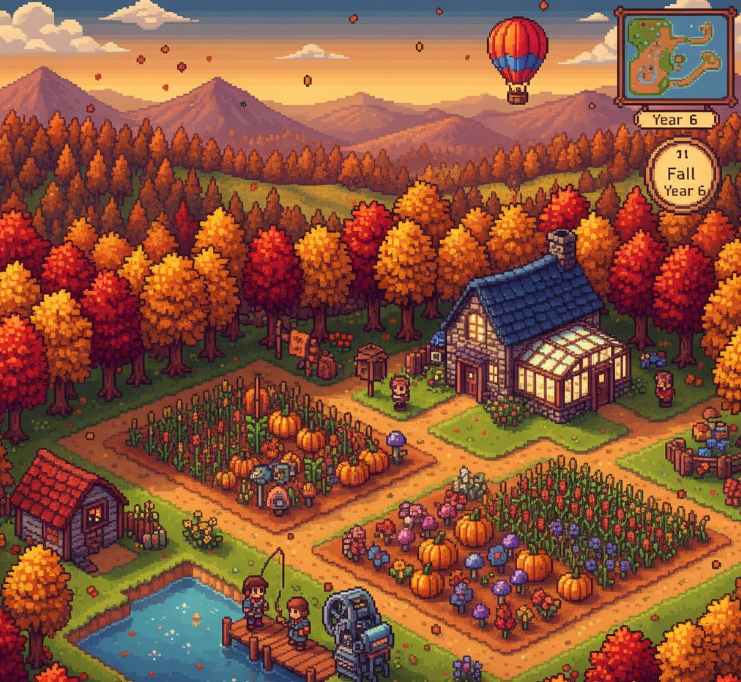
The 1.6 update specifically addressed fan requests accumulated over years. More dialogue variety so NPCs don’t repeat the same three lines endlessly. New festivals adding seasonal variety. Expanded late-game goals for players who’ve “finished” everything. Quality-of-life tweaks reducing frustration.
This ongoing support is unheard of for a game sold once at $15. No microtransactions subsidize development. ConcernedApe just genuinely cares about his creation and community. That authenticity resonates in ways corporate-developed games struggle to replicate.
The 1.6 Update Changes the Game
What’s Actually New
For players who haven’t touched Stardew since 2020 or earlier, the 1.6 update adds substantial content that refreshes the experience:
New Festivals and Events:
- Desert Festival (adding content to the underutilized Calico Desert)
- Trout Derby (fishing competition with unique rewards)
- SquidFest (another fishing event because ConcernedApe knows his audience)
Dialogue Expansion:
- Over 2,000 new dialogue lines across all NPCs
- More varied responses based on season, weather, and relationship level
- Characters reference recent events and player actions more frequently
- Marriage candidates have significantly expanded post-marriage dialogue
Quality of Life:
- New farm type focusing on meadowlands with unique benefits
- Ability to move buildings without demolishing them
- Increased pet interaction and affection systems
- Book of Powers allowing limited stat customization
- Sleeping in different beds providing various buffs
Late-Game Content:
- New quests from Mr. Qi’s challenge board
- Additional crafting recipes for endgame players
- Mastery system providing goals after skill level 10
- Secret unlockables rewarding thorough exploration
The changes seem incremental on paper but transform long-term play. NPCs finally feel like they have more than surface-level personality. The new farm type offers fresh optimization challenges. Late-game content addresses the “what now?” question that plagued veteran players.
How It Affects Different Playstyles
For Min-Maxers: The mastery system and new Qi challenges provide concrete goals beyond simply accumulating money. Optimization enthusiasts now have reasons to push boundaries rather than just sitting on millions of gold with nothing to purchase.
For Casual Players: Quality-of-life improvements reduce friction. Moving buildings without destroying them alone saves hours of frustration. The new dialogues make the world feel more alive even during routine play.
For Roleplayers: Expanded dialogue and relationship depth make character-focused playthroughs more rewarding. NPCs react to your choices more meaningfully, supporting immersive storytelling.
The Modding Scene Keeps It Fresh
Why Mods Matter for Stardew’s Longevity
Stardew Valley’s modding community is one of gaming’s most active and creative. The relatively simple structure and ConcernedApe’s mod-friendly approach enable incredible variety.
Essential mod categories in 2025:
Content Expansion:
- Stardew Valley Expanded (massive new areas, NPCs, questlines)
- Ridgeside Village (entirely new village to explore)
- East Scarp (additional town area with unique characters)
- Romance mods adding new marriage candidates
Quality of Life:
- UI Info Suite (essential information at a glance)
- Automate (connect machines for automated production)
- Tractor Mod (till, water, and harvest huge areas efficiently)
- Lookup Anything (check details on any item instantly)
Visual Overhauls:
- Seasonal outfits for villagers
- Recolor mods changing the game’s aesthetic
- Portrait replacements with different art styles
- Building and furniture reskins
Gameplay Changes:
- Difficulty adjustments (harder or easier)
- Profession overhauls changing skill trees
- New crops, animals, and recipes
- Alternative progression systems
The beauty of Stardew’s mod scene is accessibility. Tools like SMAPI (Stardew Modding API) make installation straightforward even for non-technical users. Mod compatibility is generally excellent, with most popular mods working together seamlessly.
Recommended Modded Experience for 2025
For players wanting to refresh their Stardew experience, I recommend this modded setup:
Core Expansion: Stardew Valley Expanded for massive new content Quality of Life: UI Info Suite, Lookup Anything, and CJB Cheats Menu (for quality-of-life features, not actual cheating) Visual Polish: Seasonal outfits and a portrait replacer matching your aesthetic preference Automation: Automate once you’ve experienced vanilla progression
This combination adds 50+ hours of new content while respecting the original’s design philosophy. You get a dramatically expanded world without losing what made Stardew special.
Comparing Stardew to Modern Competition
How It Stacks Up Against Newer Cozy Games
The cozy game genre exploded after Stardew’s success. Let’s examine how it compares to major competitors in 2025:
| Game | Strengths vs Stardew | Weaknesses vs Stardew |
|---|---|---|
| Animal Crossing: New Horizons | Better customization, cuter aesthetic | Less gameplay depth, real-time mechanics frustrating |
| Dreamlight Valley | Disney IP appeal, strong narrative | Grindy, aggressive monetization |
| My Time at Sandrock | 3D graphics, crafting depth | Performance issues, less charming |
| Coral Island | Beautiful graphics, more modern | Lacks Stardew’s tight game feel |
| Sun Haven | Fantasy elements, multiple towns | Overwhelming, less focused |
What Stardew still does best:
Game Feel: Movement, tool usage, and interaction are perfectly responsive. Newer games often feel sluggish or imprecise by comparison.
Progression Pacing: Stardew masterfully balances short-term goals (daily tasks) with long-term objectives (community center, relationships). Many imitators mess up this balance.
Content Density: Every NPC, every area, every system feels purposeful. Competitors often have bloat, adding features that don’t meaningfully interact.
No Monetization: You pay once, get everything forever. No premium currency, no battle pass, no FOMO tactics.
Cross-Platform Everything: Play on PC, Switch, mobile, console. Saves transfer seamlessly (within same platform family). Updates arrive consistently everywhere.
Where Competitors Excel
Fairness requires acknowledging what newer games do better:
Visual Fidelity: Modern 3D farming sims obviously look more graphically impressive than pixel art.
Accessibility Features: Some newer games include colorblind modes, difficulty options, and UI scaling Stardew lacks.
Modern Conveniences: Quest tracking, tutorials, and onboarding tend to be clearer in recent releases.
Specific Niches: Games like Wylde Flowers for narrative focus or Travellers Rest for business management offer depth in specific areas Stardew treats more broadly.
Stardew remains the best all-around cozy game, but specialized alternatives exist for players wanting specific experiences.
The Multiplayer Experience
Co-op Farm Life in 2025
Stardew’s multiplayer launched in 2018 and received significant updates through 2025. Playing with friends transforms the experience while introducing unique challenges.
What works great:
- Dividing responsibilities (one person farms, another mines, someone fishes)
- Building a farm together creating shared accomplishment
- Relationship progression with different NPCs each player pursues
- Late-game content becomes more manageable with coordination
- Split-screen console co-op for couch play
What creates friction:
- Money and resource sharing requiring trust and communication
- Calendar events potentially rushing players who prefer slow pacing
- Cabin placement and space management needs planning
- One player advancing time can frustrate those mid-task
- Relationship drama if multiple players romance the same NPC
The key to multiplayer Stardew is setting expectations. Decide beforehand if you’re playing casually or optimizing, whether you’ll share resources equally, and how you’ll handle major farm decisions. With good communication, co-op Stardew is magical. Without it, frustration builds quickly.
The addition of split-screen console play specifically improved the experience for couples and families playing together. No need for multiple systems or accounts. Just grab controllers and play.
Mobile vs PC vs Console in 2025
Platform Differences That Matter
Stardew is genuinely cross-platform, but experiences vary significantly:
PC (Steam, GOG):
- Full mod support (massive advantage)
- Mouse and keyboard ideal for inventory management
- Updates arrive first
- Best performance and load times
- Screenshot and streaming integration
Nintendo Switch:
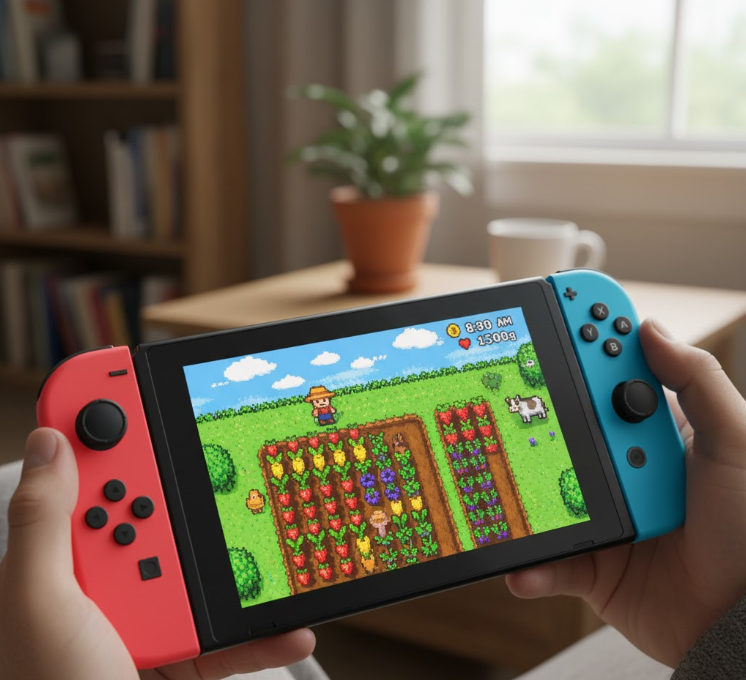
- Portable Stardew anywhere (commutes, bed, travel)
- Touch screen works surprisingly well for menus
- Local multiplayer without internet
- Updates lag slightly behind PC
- Performance occasionally hitches in late-game
Mobile (iOS, Android):
- Touch controls redesigned specifically for phones/tablets
- Play literally anywhere with cellular connection
- Cheaper than other platforms ($5-8 vs $15)
- Updates arrive last
- Small screen makes precise actions harder
PlayStation/Xbox:
- Controller optimization
- Achievement integration
- Smooth performance
- Multiplayer works well
- No mods (limitation vs PC)
My recommendation: PC for first playthrough and modding potential. Switch for portability and replays. Mobile for truly casual play. Console if you primarily game on TV and don’t care about mods.
The cross-platform availability means you can genuinely play Stardew on any device you own, which contributes significantly to its longevity.
What Still Frustrates After 9 Years
The Rough Edges That Remain
Stardew Valley is brilliant, but it’s not perfect. Some issues persist despite years of updates:
Inventory Management: The limited inventory space creates constant frustration. You’re perpetually shuffling items between backpack, chests, and fridges. Expanded storage helps but doesn’t solve the fundamental issue of managing hundreds of item types.
Early Game Energy: The first few weeks are genuinely difficult due to limited energy. New players often struggle before unlocking energy upgrades and better food. This learning curve turns some people away before the game clicks.
Combat Remains Basic: The mine combat is functional but shallow. You swing tools at monsters until they die. Compare this to dedicated action games, and it feels primitive. Some players love this simplicity; others find it tedious.
Time Pressure: The calendar creates anxiety for some players. Missing birthdays, festivals, or seasonal crops can feel bad. While you can always catch things next year, perfectionists stress about optimization.
Unclear Mechanics: Some systems lack clear explanation. Friendship decay, optimal crop choices, and hidden game mechanics require wiki consultation. The game prefers discovery over tutorials, which frustrates some players.
Performance in Late-Game: Massive farms with hundreds of objects can cause slowdown, especially on Switch. The game wasn’t optimized for extreme setups, and sprawling farms occasionally stutter.
These issues are manageable with experience or mods, but they represent the few areas where Stardew shows its age and one-person development origin.
The Community and Culture
Why the Fandom Endures
Stardew Valley’s community in 2025 remains incredibly active and positive, which is rare for a nine-year-old game.
Active community spaces:
- r/StardewValley (2M+ members, daily activity)
- Discord servers for general play and modding
- YouTube with endless content from major creators
- Twitch streamers doing challenge runs and casual farms
- Wiki maintained by passionate volunteers
The community culture is notably wholesome. Players share farm layouts, discuss optimal strategies, create fan art, write fanfiction about NPCs, and genuinely support each other. Toxicity is remarkably low compared to most gaming communities.
Why the community stays engaged:
- Constant new player influx from sales and word-of-mouth
- Veteran players returning for updates or modded content
- Speedrunning and challenge communities creating new goals
- Shared love for ConcernedApe and his continued support
- The game’s inherently non-competitive nature reducing toxicity
The modding community specifically deserves recognition for keeping Stardew fresh. Talented creators produce free content rivaling professional DLC, sustained purely by passion for the game.
Challenge Runs and Replayability
Keeping It Fresh After Hundreds of Hours
If you’ve completed Stardew “normally,” challenge runs provide entirely new experiences:
Popular challenges in 2025:
Joja Route: Side with the evil corporation instead of completing the Community Center (guilt-inducing but interesting)
Beach Farm No Sprinklers: The beach farm prohibits sprinklers, forcing manual watering and strategic planning
Skull Cavern 100 Floors Year 1: Reaching floor 100 in the dangerous mine within the first year requires extreme optimization
No Wiki Run: Play without external resources, discovering everything organically (surprisingly difficult)
Rancher Only: No crops, only animal products for income
Foraging Focus: Survive primarily through gathering rather than farming
Speedrun: Complete objectives as fast as possible (active speedrunning community with optimized routes)
Perfection Hunting: Achieve 100% completion on the perfection tracker (extremely time-consuming)
These self-imposed restrictions breathe new life into familiar systems. A beach farm no-sprinkler run fundamentally changes your approach to farming. Joja route provides entirely different progression. Speedrunning reveals optimization possibilities most players never consider.
Is It Still Worth Playing in 2025?
For New Players
If you’ve never played Stardew Valley, you’re in an enviable position. You get to experience one of gaming’s modern classics in its most polished form with years of free updates baked in.
You should absolutely play Stardew Valley if:
- Cozy, low-stress games appeal to you
- You enjoy progression systems and optimization
- Building and customizing spaces satisfies you
- You want hundreds of hours of content for $15
- Charming pixel art doesn’t bother you
- You appreciate games made with obvious love and care
You might skip or wait if:
- You need cutting-edge graphics and modern visuals
- Time management stresses you rather than engages
- You prefer action-heavy gameplay
- Pixel art actively turns you off
- You’ve tried similar farming sims and bounced off
- You need explicit tutorials explaining everything
For most players, Stardew Valley absolutely justifies the modest asking price and time investment. It’s accessible enough for casual players while deep enough for hardcore optimization enthusiasts.
For Returning Players
If you played Stardew years ago and haven’t experienced recent updates, returning is worthwhile:
Return if:
- You stopped playing before 1.5 (Ginger Island is substantial)
- The 1.6 update changes intrigue you
- You never tried multiplayer
- Modding interests you
- You want a comfort game during stressful times
Maybe wait if:
- You recently played through a complete save
- You’re burned out on the core loop
- You’re waiting for theoretical Stardew Valley 2 news
The beauty of Stardew is you can always return. Your old farms still exist. The game will always be there when you need it. No servers shutting down, no content vaulting, no season passes missed. It’s permanent comfort food.
The Cozy Game Crown
Does Stardew Still Reign Supreme?
After extensive time with both Stardew and its competitors, here’s my honest assessment:
As pure game design: Yes, Stardew Valley remains the best cozy game. The tight game feel, perfect progression pacing, and interconnected systems are still unmatched. Newer games look prettier but rarely feel as good to play.
As complete package: Absolutely. The price-to-content ratio is absurd. Free updates for nine years. No monetization. Cross-platform support. Active community. Extensive modding. Nothing else offers this value.
As gateway to cozy gaming: Definitely. Stardew is the perfect introduction to farming sims and cozy games. It’s accessible without being shallow, challenging without being punishing, and charming without being saccharine.
As only cozy game you’ll ever need: Maybe not. While Stardew excels overall, specialized games offer things it doesn’t. Animal Crossing’s real-time charm, Dreamlight Valley’s Disney magic, or Sun Haven’s fantasy elements provide experiences Stardew can’t replicate.
The competition has gotten stronger. Games like Coral Island and Travellers Rest push specific aspects of the formula forward. But as an all-around package balancing farming, combat, relationships, exploration, and progression, Stardew Valley remains king in 2025.
Conclusion
Stardew Valley in 2025 is the rare game that’s simultaneously a perfect time capsule of 2016 indie gaming and a living, evolving experience. ConcernedApe’s continued free updates, the thriving mod community, and the game’s fundamental design excellence ensure it remains relevant nearly a decade after release.
Is it still the best cozy game? For most players, yes. The combination of responsive gameplay, rewarding progression, charming aesthetics, and incredible value makes it the gold standard against which all farming sims are measured. Newer games may look prettier or offer novel mechanics, but few capture the magic of Pelican Town.
The game’s greatest strength is its timelessness. The pixel art won’t age. The core mechanics remain satisfying. The progression systems still hit that dopamine button perfectly. Stardew Valley will be playable and enjoyable in 2035 just as it is today, which can’t be said for live-service competitors that’ll shut down servers and disappear.
Whether you’re discovering Pelican Town for the first time or returning after years away, Stardew Valley welcomes you home. Your farm is waiting. The villagers remember you. And there’s always one more crop to plant, one more floor to reach, one more person to befriend.
Just one more day. One more season. One more year.
We’ll see you at sunrise, farmer.
What keeps bringing you back to Stardew Valley, or what’s preventing you from trying it if you haven’t? For veterans, what’s your most memorable farm moment or proudest achievement? For newcomers, what questions do you have before diving in? Share your Stardew stories in the comments. This community is genuinely one of gaming’s friendliest, and I’d love to hear what makes this game special to you.
FAQ: Stardew Valley 2025
Is Stardew Valley worth it in 2025?
Absolutely yes. Stardew Valley remains the best value in cozy gaming at $15 (often on sale for less). Nine years of free updates mean new players get the most complete version ever. The core gameplay loop is timeless, the pixel art hasn’t aged poorly, and hundreds of hours of content await. For new players, there’s no better time to start. For veterans, recent updates provide reasons to return.
What’s the best platform to play Stardew Valley?
PC offers the definitive experience with full mod support, best performance, and earliest updates. Nintendo Switch excels for portable play and local co-op. Mobile versions work surprisingly well for $5-8 but update slowest. PlayStation and Xbox provide solid console experiences with achievements. Choose based on your priority: mods (PC), portability (Switch), price (mobile), or couch gaming (console).
Can you play Stardew Valley casually or does it require grinding?
Stardew Valley accommodates both casual and hardcore play beautifully. You can play 30 minutes daily doing basic farm tasks, or optimize every action for maximum efficiency. There’s no “wrong” way to play. The game doesn’t punish casual approaches, and you can’t truly fail. Take as many in-game years as you want to complete objectives. The only time pressure is self-imposed.
Is Stardew Valley multiplayer good?
Multiplayer works well with good communication but requires coordination. Playing with friends who divide responsibilities (farming, mining, fishing) creates satisfying teamwork. However, shared resources and calendar progression can cause friction without clear expectations. Split-screen console co-op is excellent for couples and families. Overall, multiplayer transforms the experience positively if all players commit to collaboration.
Do I need mods to enjoy Stardew Valley?
No, vanilla Stardew Valley is excellent and complete without mods. ConcernedApe designed a fully realized experience that doesn’t require modifications. However, mods can enhance replayability after completing vanilla content. Quality-of-life mods reduce tedium, while content mods like Stardew Valley Expanded add substantial new areas and characters. Try vanilla first, then explore mods if you want more.
Sources & Additional Resources
- Stardew Valley Official Website – ConcernedApe’s Site – Official news, updates, and patch notes directly from the developer
- Stardew Valley Wiki – Comprehensive community-maintained database covering all game mechanics, items, and secrets
- r/StardewValley Subreddit – Active community for sharing farms, asking questions, and discussing strategies with 2M+ members